AI agent guardrails are policy checks placed around model inputs, outputs, and tool calls. They can reject a malicious request, flag sensitive data, constrain a tool call, or stop an unsafe final answer. They cannot prove that a model has understood policy, eliminate prompt injection, or replace authorization in the systems an agent can reach. The practical design is layered: use guardrails for detection and routing, least-privilege credentials for containment, deterministic backend checks for enforcement, and human approval for high-impact actions.
Guardrails are controls, not a security boundary
The word guardrail is used loosely. In a production agent, it should mean a specific control with a defined input, decision, and failure behavior. A classifier that detects personal data is a guardrail. A schema validator that rejects an invalid transfer amount is a guardrail. A human approval step before sending an email is also a guardrail. A prompt that merely tells the model to “be safe” is an instruction, not an enforceable boundary.
OWASP’s 2025 prompt-injection guidance says that prompt injection can influence critical decisions, expose data, and reach functions available to the model. It also states that there is no known foolproof prevention method and recommends layered mitigations, including output validation, least privilege, human approval, separation of untrusted content, and adversarial testing. See OWASP LLM01:2025 Prompt Injection.
That distinction matters because the cost of a missed classification depends on what happens next. A missed policy violation in a read-only summarizer may produce a bad answer. The same miss in an agent with a privileged database credential may delete records. OWASP calls the latter class of exposure excessive agency, whose common causes are excessive functionality, excessive permissions, and excessive autonomy. Its recommended mitigations include minimizing tools and permissions, avoiding open-ended tools, requiring approval, and enforcing authorization in downstream systems. See OWASP LLM06:2025 Excessive Agency.
What each guardrail layer can catch
| Layer | Useful for | Typical misses | Safe failure |
|---|---|---|---|
| Input | Known attack patterns, prohibited requests, obvious secrets, malformed fields | Obfuscation, multilingual attacks, indirect instructions retrieved later | Reject or route to a restricted workflow |
| Retrieval | Source allowlists, document trust labels, provenance requirements | Compromised allowed sources, instructions hidden in valid documents | Exclude untrusted context and preserve citations |
| Model output | Schema violations, data leakage patterns, unsupported answer formats | Confident but plausible errors, subtle policy violations | Withhold, regenerate, or escalate |
| Tool input | Invalid arguments, dangerous destinations, amounts above policy limits | Semantically harmful requests that still satisfy the schema | Block before side effects occur |
| Approval | High-impact or irreversible actions | Reviewer fatigue, misleading summaries, approvals without enough context | Pause with full arguments and reject by default |
| Backend authorization | Identity, tenant boundaries, object permissions, transaction limits | Policy defects in the backend itself | Deny independently of model output |
Input and output filters are useful, but the most important control is often the one closest to the side effect. If an agent can call send_email, validate the recipient, attachment scope, tenant, and authorization at the tool boundary. If it can issue a refund, the payment service—not the language model—must enforce account ownership and refund limits.
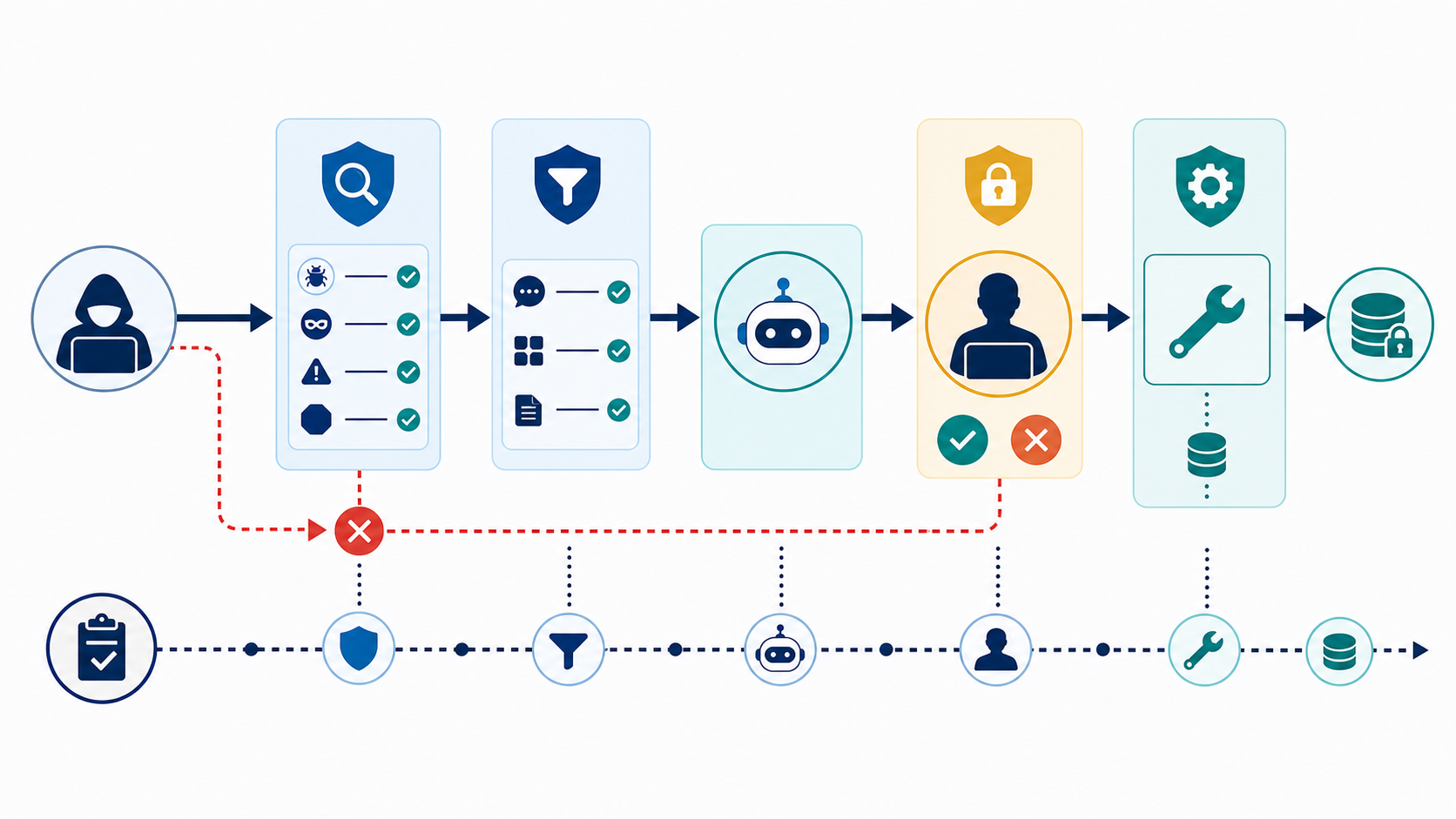
Five ways guardrails fail in real systems
1. The filter sees only the first message
An agent may retrieve webpages, files, tickets, or messages after the initial user request. A clean first message does not make later context trusted. This is the core problem behind indirect prompt injection. Treat every external source as untrusted data, retain its provenance, and apply controls again before a retrieved instruction can influence a tool call. For a deeper threat model, read Prompt Injection in RAG and Tool-Using Agents.
2. A parallel check loses the race
Some frameworks run an input guardrail concurrently with the agent to reduce latency. That is reasonable for low-risk classification, but it can be unsafe when the agent may execute a side-effecting tool before the check finishes. The current OpenAI Agents SDK guardrails documentation explicitly distinguishes parallel and blocking execution: blocking input guardrails finish before the agent starts, while parallel checks may allow token use or tool execution before cancellation. Use blocking checks whenever a miss could trigger an external action.
3. A valid schema hides an invalid intent
Structured output reduces syntax errors; it does not establish authorization. The JSON {"account_id":"A17","amount":500} can be perfectly valid while referring to another customer’s account. Resolve identity from the authenticated session, not from model-supplied fields, and re-check object-level access inside the tool or downstream service.
4. Approval becomes a rubber stamp
Approval works only when the reviewer sees the actual action, arguments, target, and expected effect. A vague prompt such as “Approve the agent’s request?” invites automation bias. Show a deterministic preview: “Send this exact message to these three recipients” or “Delete these four records.” Expire stale approvals, bind each decision to a specific call ID, and reject when the request changes.
The OpenAI Agents SDK human-in-the-loop guide provides one concrete implementation: sensitive tool calls interrupt a run, expose the tool name and arguments, and resume from serialized state after a person approves or rejects the specific call. Other frameworks use different APIs, but the security property should be the same.
Using another model as a judge can improve coverage, but it remains probabilistic. It may inherit similar weaknesses, drift after a model update, or be manipulated by the same untrusted content. Combine model-based classification with deterministic rules where possible, isolate the judge from unnecessary context, and evaluate it against a maintained adversarial dataset.
A practical layered architecture
- Classify risk before execution. Map each workflow to read-only, reversible write, irreversible write, financial, privileged-data, or external-communication risk.
- Constrain available tools. Give each agent only the functions needed for its current task. Prefer
read_invoiceover a generic SQL or shell tool. - Validate every tool call. Apply schemas, allowlists, range limits, tenant checks, and policy rules before execution.
- Require approval for high-impact actions. Bind approval to the exact call and arguments. Do not persist broad approval longer than necessary.
- Enforce downstream authorization. Use the end user’s identity or a narrowly scoped service identity. Never treat an LLM’s statement of permission as proof.
- Log the decision path. Record input provenance, guardrail results, tool arguments, approvals, backend decisions, and final outcomes with appropriate redaction.
This architecture complements the broader controls in How to Secure AI Agents in 2026, including credential isolation, sandboxing, observability, incident response, and dependency management.
How to test guardrails before production
NIST describes its Generative AI Profile as a cross-sector companion to the AI Risk Management Framework intended to help organizations incorporate trustworthiness into the design, development, use, and evaluation of AI systems. For an agent team, that means treating guardrail testing as an ongoing engineering process, not a one-time prompt review.
Build a test set around decisions, not clever prompts
Start with the actions your system must allow or deny. Each case should include the user request, retrieved content, expected tool sequence, expected approval state, expected backend decision, and final outcome. Include at least these groups:
- normal allowed tasks, including uncommon but legitimate inputs;
- direct policy violations and obvious injection attempts;
- indirect instructions inside webpages, documents, emails, and tool results;
- obfuscated, encoded, multilingual, and multi-turn attacks;
- cross-tenant object references and privilege-escalation attempts;
- invalid, oversized, missing, and boundary-value tool arguments;
- approval rejection, timeout, replay, mutation, and stale-state cases;
- backend denial even when earlier guardrails incorrectly allow the request.
Measure outcomes at every layer
A single “guardrail accuracy” number hides the failures that matter. Track:
- unsafe execution rate: prohibited tool calls that actually produced a side effect;
- false-negative rate: adversarial cases incorrectly allowed;
- false-positive rate: legitimate tasks incorrectly blocked;
- approval bypass rate: sensitive calls executed without the required decision;
- authorization containment: attempts that reached the backend but were denied correctly;
- latency and cost overhead: added by blocking checks, judge models, retries, and review queues;
- trace coverage: runs with enough evidence to reconstruct the final action.
Run the suite whenever you change the model, system prompt, tool description, retrieval pipeline, policy, or permission scope. Sample production traces only under a documented privacy and retention policy. OpenAI’s trace grading documentation describes grading end-to-end traces—including decisions and tool calls—to identify errors, compare changes, and detect regressions. The same principle applies regardless of vendor: evaluate the path, not only the final text.
Release gate checklist
- Every side-effecting tool has deterministic argument validation.
- Every downstream request enforces user and tenant authorization independently.
- High-impact actions pause before execution and show exact arguments to a reviewer.
- Retrieved and tool-returned content is labeled and treated as untrusted.
- Blocking checks run before any action that cannot safely race.
- The adversarial suite includes indirect, multi-turn, encoded, and authorization cases.
- Tests fail the build on unsafe execution, not merely on an undesirable final answer.
- Production traces can reconstruct what the agent saw, decided, requested, and executed.
- There is a kill switch or capability revocation path for incident response.
Bottom line
A good guardrail can reduce unsafe inputs and outputs. A secure agent system assumes that every guardrail can still miss. Put the strongest controls closest to the consequence: narrow tools, narrow credentials, exact approvals, and deterministic backend authorization. Then test the entire action trace with both allowed and adversarial cases. The goal is not to make the model infallible; it is to keep one model mistake from becoming an unauthorized real-world action.
Sources
Building an AI agent?
If you are preparing an AI agent, RAG workflow, or tool-using LLM application for production, IBBS.AI offers a practical readiness audit covering prompt injection, guardrails, tool permissions, task success, cost, and latency.